

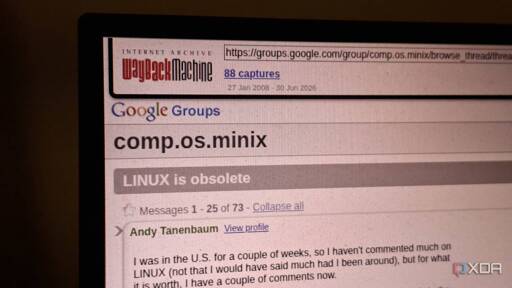
It powers servers, smartphones, a growing number of personal computers, and at least three gaming consoles (Deck, Machine, Legion Go S), with more coming.
Windows was called obsolete (by me) years ago, and it’s abandoned (by me) since mid 2024.
That statement really has the same vibe as the one in the post. Well done.
In 1987, Bill Gates predicted in an interview that in 3 years time, 80% of new office systems would be based on OS/2, an operating system from IBM.
The first release of Windows was in 1985, so that Computerworld interview was basically Bill Gates calling Windows obsolete.
my kind of authority
“was called obsolete” - by 1 person who happened to be the developer of a competing OS/kernel.
Tanenbaum also believed that the Intel x86 was on the way out, the very CPU that Linux was hard-coded to run on. On the other hand, Minix was ready to adopt the upcoming RISC tech, which Tanenbaum believed would drive the x86 into extinction.
A genuine Nostradamus, here.
Kinda wish he was right about risc tbh
I would argue he was, but it’s taking far longer than I’d like
And was Linus’s teacher for Operating Systems in HelsinkiWrite the book on Operating Systems that Torvalds said inspired him to make Linux.
At university?
You mean docent I presume. Universities do not exactly have teachers.
Resident or visiting?
I think universities do have teachers, but that’s beside the point.
Anyway I misremembered and it was just that Tanenbaum wrote the OS book that Torvalds had during undergrad.
… and millions of phones 🙃
And your car and likely your fridge too. Linux is everywhere.
I mean, if it were for novelty and “cleverness” then it would be Plan-9 (or BeOS) the one who shoulda take over. At the end of the day both Linux.and Minix are both following the UNIX model which even at that time it already was “obsolete”. But reality is often more pragmatic
Honestly plan9 is neat but it suffers from being incredibly stringy and so does Linux / unix.
There’s some new paradigms out there that probably need to be uncovered. Computers have way more processing capabilities then they did in the 90s
More processing power means new paradigms are less likely to be uncovered, I think. The deficiencies of current designs are obscured, and maybe moot, due to the raw power the processors. There isn’t any real pressure to improve kernel design.
All of the big current kernels (NT, Linux, XNU) are rooted in the i386 era. There’s certainly been a lot of changes in all of them but I don’t know if any have been completely re-architected.
Might have to wait for some kind of completely new processor before we see completely new kernels.
The point was microkernel vs monolith
Always has been
It’s a old design shoe horned to do modern things. That’s fine but yeah… Obviously something more modern would be nice.
And it captured our hearts along the way. I bet few of us knew it existed in '92.
How? Torvolds released the Linux kernel in 91, lol.
Oh, maybe because UNIXWare 1.0 (System V 4.2) came out in 1992, the first major release in years. :P 🖕
Linux obsolete before windows 95 , lol
Called “obsolete” by whom? Microsoft?
Andy Tannembaum. Mi ix is microkernel. Linux is monolithic
I’ve been there with the MINIX debate back then. I’ve actually used MINIX on a job back then. Tannenbaum knows his stuff, but with that, he was completely off. I don’t think that most people in the Linux scene nowadays have ever heard of him or his OS. So much for relevance.
Reading is hard, isn’t it?
Especially when the linked article does not open, yes.
And it’s in the big bold title…
The image reads Andy Tannenbaum.
Ah, OK, the Tannenbaum discussion. Yes, we had good laughs back then.
No, Microslop called it a “cancer”.
That, too.


