

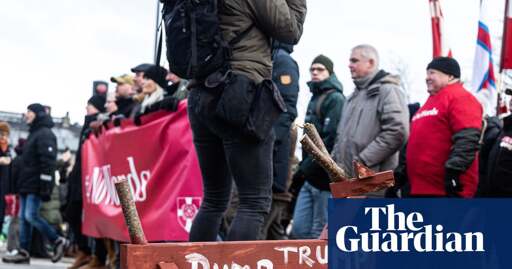
Large majorities in six nations express antipathy to Trump’s US and support European self-assertion
Western Europeans prize Europe’s autonomy and values over transatlantic ties and will not give them up to placate Donald Trump, according to a poll suggesting opinions of the US have plunged to their lowest since YouGov began tracking them a decade ago.
The US president’s attempted Greenland grab has succeeded in turning Europeans solidly against his country, the pollster’s latest survey found. Large majorities in Denmark, France, Germany, Italy, Spain and Great Britain all declared an unfavourable opinion.
The figures, ranging from 62% in France to 84% in Denmark – of which Greenland is a self-governing territory – mark a further steep rise in negative perceptions of the US even since November, when the range was between 49% and 70%.
US power stems directly from its dollar position. Its status as reserve currency is a force multiplier. The immediate step is to reduce exposure to it, which disproportionately reduces US power in the short term.
The longer this goes on, the more systems decouple from the USA and correspondingly the less power and influence they have.
Soft power stems from its ability to cut individual nation-states off from global trade. But if you take a hard look at, say, North Korea or Cuba or Venezuela or Iran, you’ll notice that it’s not simply access to legal international markets that causes their poverty. These countries are physically encircled by US military. Cuba, in particular, is ringed in by US warships with an entrenched beach head at Guantanamo Bay.
And it goes without saying that these countries are constantly under threat of espionage, plagued by disinformation, and periodically sabotaged by US special forces.
The dollar position is a consequence of these interventions, dating back to the Cold War Era.
It’s been going on since Truman. Arguably back to McKinley. The US has been a fountain of militant white nationalism for centuries.
Meanwhile, European corporate media seems vastly more paranoid and fearful of infiltration by Eastern adversaries. Muslims coming up through Turkiye or crossing north of the Mediterranean. Russians driving tanks all the way from Moscow to Berlin. Chinese businessmen stealing European jobs, Orientalizing markets, and corrupting the fragile innocent young minds of the liberal intelligentsia.
I just don’t see decoupling happening (in my lifetime). Trump will lose his grip on power, US neoliberals will retake the federal government, and we’ll have another wave of “normalization” that settles anxious Europeans just long enough for Palantir and News Corp and JP Morgan and Microsoft to secure their hooks a bit deeper.
This is a bit of a “all or nothing” fallacy. It admits to degrees. It’s like someone saying that they can’t be vegetarian because they like bacon. Dude, just cut out everything except bacon, it’s fine.
Countries reducing their exposure to USD is still a good step, given how unreliable a partner the USA has been the last decade. You don’t have to fully dump all your USD bonds to add resilience to your financial system.
I don’t see “normalization” with Canada happening after trump has gone. Sure, relations will improve but the distrust will last for decades and there will continue to be a divergence economically, militarily, and culturally. We can never again allow ourselves to be integrated with another country to the point of dependency.
What can an ordinary person do about this? I moved my savings to ETFs that specifically exclude the US the moment Trump was elected. But my debit card is connected to Mastercard and there’s no europan alternative in my country. Or is it more about the big picture and not what I personally do or avoid?
It’s definitely something that needs to be attacked at a systems level, not a personal one. Divesting your own investments is a small step. Writing your MP is another step. Telling your union’s retirement fund that you’d like them to divest is another step.
Many raindrops make an ocean, I suppose. But there are some people who control rivers that we can influence in a small way.