

cross-posted from: https://lemmy.sdf.org/post/49968113
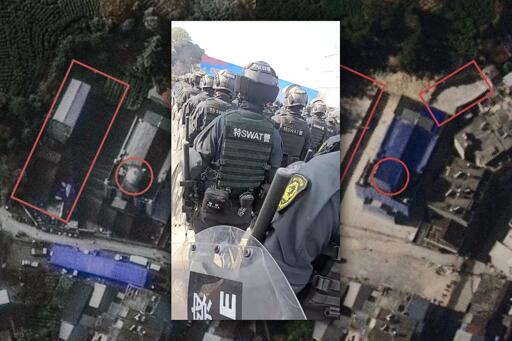
The residents of this rural Chinese town had never witnessed anything like it. Around 10 pm on Sunday, December 14, law enforcement descended by the hundreds on the streets of Yayang. Videos posted on Chinese social media and geolocated by Le Monde showed officers moving into the town, wearing helmets and armed with batons and riot shields.
The day before, dozens of wanted notices had been plastered on the walls of this town of several thousand people. Underneath two portraits of men staring out at passersby, the notices read: “Please report any unlawful acts committed by Lin Enzhao, Lin Enci and their criminal gang (…), accused of provoking quarrels and disturbing public order.” This particularly vague offense has become the Chinese Communist Party’s tool of choice to stifle dissent. According to testimonies collected by Le Monde, the two brothers led services at the Yayang protestant church, which was built nearly 30 years ago.
…
Three weeks after the Yayang operation, police targeted another house church in Chengdu. Six of its leaders were imprisoned and charged with similar offenses as those cited in Yayang. In October, one of China’s main house churches, present in some 40 cities, was targeted. Its founder and 20 other church leaders remain imprisoned.
…
According to a local Christian interviewed by Le Monde, it has become impossible for believers to worship freely in the district: “Services are now monitored by government agents in the churches. Many are preparing to stop gathering there and return entirely to the model of house churches.”
These “house churches” began to develop at the end of the Cultural Revolution (1966-1976), thanks to a period of relative tolerance by the government. Initially limited to the private sphere, they gradually grew into public places of worship, and today are believed to include tens of millions of believers across China. They differ from the official Christian faith (44 million followers in 2018, according to Beijing), which is practiced under the supervision of the Communist Party through a tightly controlled national patriotic association.
But Xi Jinping’s rise to power changed the situation. “Since he took office, the relatively controlled freedoms religions enjoyed since the 1980s have been sharply curtailed,” explained Julie Remoiville, a specialist in Chinese religions. “Ideological control has greatly intensified, and Xi Jinping has had many places of worship, including churches, destroyed.”
…
So, I did a little digging on this group - the Yayang Church Network - because I was curious to know the details.
Turns out, there’s a prohibition in China against church attendance for minors. China does not allow anyone under 18 years old to attend religious services or receive religious education under a set of policies rooted in the Regulations on Religious Affairs (revised in 2018) and in the government’s broader mandate to “separate religion and education.”
The Yayang Network operates in open defiance of this rule. It’s leadership - specifically a pair of evangelical pastors named Lin Enci and Lin Enzhao - have made it a practice to openly and publicly denounce the law in services where parents are encouraged to bring young children. And this police action is in response to these organized religious protests.
Now, I’ve been in the Reddit/Lemmy community for a while. And… historically… these sites have been pretty nakedly against religious indoctrination of young people. There’s also a strong anti-natalist sentiment which might run afoul of church’s progenitor - Watchman Nee or Nee T’o-sheng - whose evangelical traditional outlook encouraged large families in strict defiance to the Chinese One Child Policy.
So I do have to wonder if people on this site are going to be outraged at China for religious persecution generally speaking. Or if they’re actually sympathetic to the Yayang Network’s evangelical traditions and founding beliefs.
I can easily dislike both.
Sure. But you still need to square the circle on public policy.
Are you in favor of minors being forced to attend religious services by their parents or not? Should this forced attendance be a prosecutable offense or not? Should repeat offenders be arrested and charged or allowed to operate in defiance of these rules indefinitely?
As we saw under Biden, liberals love to say they have strong moral convictions. But they hate the idea of actually enforcing any of them.
So, assuming you’re fine with the Yayang Network continuing to operate, you also have to ask yourself… are you going to be happen when these people are running your town? Your state? Your country?
My moral convictions are more of the situational kind… In this case, I don’t know enough about the particular events to actually have a qualified opinion, and it’s not important enough to me to do the research. I’m content to dislike the ccp for being an oppressive near-dictatorship under Xi, and this random church I’ve never heard of for indoctrinating children (which all churches do, or they’d soon go extinct). On the balance, I probably dislike the heavyhandedness of the reaction more than the religious practice in this instance, but not with any strong conviction.