
• 0 Posts
  • 10 Comments
Joined 2 months ago
cake
Cake day: January 1st, 2026

help-circle

  • While I agree, I don’t think the language “every operating system provider has to create” means it’s installed if you don’t want it. Parental control software exists for Linux, it’s available from the package manager, and we can opt out of installing it.

    I doubt “every operating system” is meant literally. Embedded OSs for specialized hardware (eg, routers, satellites, rockets, missiles, drones, calculators, industrial lasers) aren’t typically meant for children to browse the web. If TempleOS supported networking, it might be in trouble. Viable legislation would probably be restricted to OSs designed to allow children to access content over the internet.

    The main thrust of the suggestion is to prefer parental controls over age verification. Better ways to ensure availability of parental controls (like government services to provide the software free) fit that broad idea.

    I can make its logic gates do anything I want, as long as it’s not sending CP or malware over the Internet.

    That stipulation doesn’t need to be stated. It can be programmed to do anything, and that’s fine. Laws already exist for illegal activity. Anyone who’d fuss the absence of that stipulation lacks credibility.

  • Cool: agreed. Your objection was ambiguous.

    If we had to choose, though, I’d consider the professor’s suggestion preferable to age verification. While I disagree with mandating it, it’d pretty much do nothing, because it’s already reality: most mainstream OSs include parental controls. The “criteria” would establish standards for parental controls, which isn’t altogether a bad idea. A better idea would be to promote a standard & replace mandates with public services to provide parental control technologies free & to educate parents.

    In the late 90s, when US Congress attempted to regulate access of adult content to minors, those laws commissioned studies that drew similar conclusions even then. The studies & federal courts concluded that to meet the government’s compelling interest in “protecting minors from harmful content”, there were more narrowly tailored alternatives to criminalization & age verification that are less restrictive to fundamental rights & are at least as effective:

    • client-side filters to block content from the receiving end
    • government programs to train parents & provide them resources to “protect” their children from “harmful content”
    • public education campaigns.

    They pointed out while client-side filters may have false positives & negatives

    • they can be monitored & corrected
    • they’re a more complete solution that can restrict all internet protocols (not just web) from any geographic source (not only in legal jurisdiction) with content of any type (including dynamic such as live chat)
    • they allow restriction of other kinds of content (eg, violence, hate speech)
    • they can vary restrictions per child (eg, age-appropriateness)
    • they let parents disable them
    • they don’t obstruct access by adults.

    Criminalizing access to adult content at the source obstructs everyone’s access & burdens them with loss of privacy & with security risk.

    Despite their age, those studies’ findings remain relevant.

    • COPA Commission

      In October 1998 Congress enacted the Child Online Protection Act and established the Commission on Online Child Protection to study methods to help reduce access by minors to certain sexually explicit material, defined in the statute as harmful to minors. Congress directed the Commission to evaluate the accessibility, cost, and effectiveness of protective technologies and methods, as well as their possible effects on privacy, First Amendment values and law enforcement. This report responds to the Congressional request.

    • National Research Council

      In November 1998, the U.S. Congress mandated a study by the National Research Council (NRC) to address pornography on the Internet (Box P.1).

    COPA Commission summary

    The COPA Commission found Age Verification ID to have the highest adverse impact on cost, privacy, fundamental rights, and law enforcement and to score poorly on effectiveness and accessibility. They found other technologies & methods to be more effective & accessible with much lower adverse impact including

    • client-side filtering
    • family education programs
    • acceptable use policies
    • top-level domains for materials “not harmful” to minors
    • “greenspaces” containing only child-appropriate materials.

    Some recommendations to highlight

    Public Education:

    • Government and the private sector should undertake a major education campaign to promote public awareness of technologies and methods available to protect children online.
    • Government and industry should effectively promote acceptable use policies.

    Consumer Empowerment Efforts:

    • Resources should be allocated for the independent evaluation of child protection technologies and to provide reports to the public about the capabilities of these technologies.
    • Industry should take steps to improve child protection mechanisms, and make them more accessible online.
    • A broad, national, private sector conversation should be encouraged on the development of next-generation systems for labeling, rating, and identifying content reflecting the convergence of old and new media.
    • Government should encourage the use of technology in efforts to make children’s experience of the Internet safe and useful.

    Industry Action:

    • The ISP industry should voluntarily undertake “best practices” to protect minors.
    • The online commercial adult industry should voluntarily take steps to restrict minors’ ready access to adult content.
    NRC summary

    The NRC found “no single or simple answer”, agreed on the capabilities of filters in preventing inadvertent or unhighly-motivated exposure, but also stressed social & educational strategies in addressing motivation, coping, & responsible behavior.

    Social and educational strategies are intended to teach children how to make wise choices about how they behave on the Internet and to take control of their online experiences: where they go; what they see; what they do; who they talk to. Such strategies must be age-appropriate if they are to be effective. Further, such an approach entails teaching children to be critical, skeptical, and self-reflective of the material that they are seeing.

    An analogy is the relationship between swimming pools and children. Swimming pools can be dangerous for children. To protect them, one can install locks, put up fences, and deploy pool alarms. All of these measures are helpful, but by far the most important thing that one can do for one’s children is to teach them to swim.

    Perhaps the most important social and educational strategy is responsible adult involvement and supervision.

    Internet safety education is analogous to safety education in the physical world, and may include teaching children how sexual predators and hate group recruiters typically approach young people, how to recognize impending access to inappropriate sexually explicit material, and when it is risky to provide personal information online. Information and media literacy provide children with skills in recognizing when information is needed and how to locate, evaluate, and use it effectively, irrespective of the media in which it appears, and in critically evaluating the content inherent in media messages. A child with these skills is less likely to stumble across inappropriate material and more likely to be better able to put it into context if and when he or she does.

    Education, supervision, & parental controls/filters seem a more compelling solution. However, bring that up in regard to legislation to age-restrict social media & the tune at lemmy dramatically changes: seems inconsistent.


  • you don’t stop misogyny by just ignoring it you twats, and hot take, mainstream social media

    Opinions aren’t stopped. They also don’t need to be. Trying to make individualism a put-down is pathetic.

    We all have it in our power to ignore or use our voices to promote our messages with as much force as the messages we oppose. That provocative ragebait engages more effectively than constructive dialog reflects a human failing & a need to work on ourselves.

    Social media doesn’t need to be good, and we don’t need to keep using it. The beauty of social media is we can be totally irredeemable “twats”, victim-blame up the wazoo, and put out the most infuriating shit conceived until we realize it’s all expression lacking substance & none it matters. It’s only when people start caring too much that we should be concerned for humanity. They need to get a life or something, stop putting so much of themselves on words, images, & sounds on a screen.
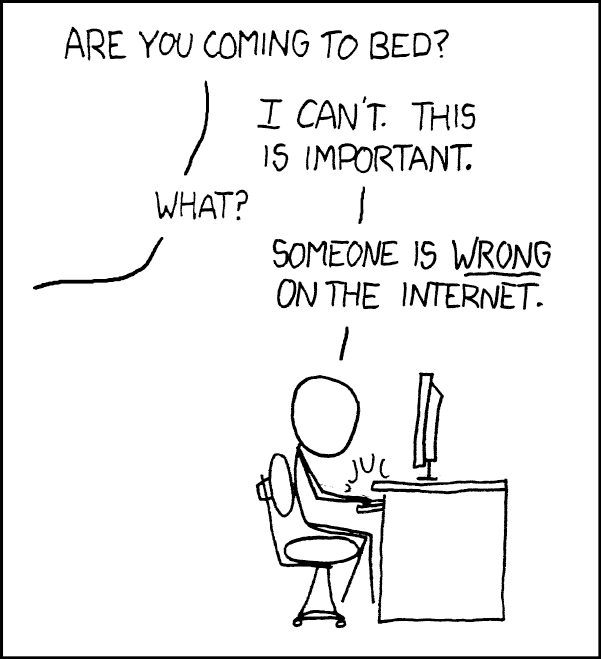
    comic: are you coming to bed?
I can't. this is important.
what?
someone is wrong on the internet.


  • Do you have any analysis to substantiate your claims like the articles I linked?

    The historical record of congressional party control shows that in the past 4 decades Democrats have rarely had enough control of both chambers to pass legislation without bipartisan support. Democrats (& independents caucusing with them) have had

    Even with a majority, Democrats aren’t a monolith: they still have factions. Overcoming Senate filibuster requires 3/5 supermajority. Enacting legislation still requires presidential approval or veto override with 2/3 supermajority from both chambers. Veto overrides are rare & typically bipartisan, especially the last one, which was against Trump. Consequently, deliberation & compromise to broadly appeal to their own party & enough of the opposition is a practical necessity.

    Moreover, Trump was impeached twice. They simply lacked the 2/3 supermajority in the Senate to convict due to insufficient bipartisan support.

    The 1st impeachment split by party almost exactly:

    • impeachment passed with a simple majority without Republicans
    • conviction votes for 1st & 2nd charges didn’t even get a simple majority.

    The 2nd impeachment on 2021/1/13 was only days after the 2021/1/6 incitement of insurrection. Despite some Republican support, not enough were willing to defy Trump.

    • impeachment passed with some Republican support (all 222 Democrats + 10 Republicans)
    • conviction failed with a simple majority approving conviction (all 50 Democrats + 7 Republicans).

    Failure to convict on 2021/2/13 imperiled chances of a federal criminal case against Trump’s actions during presidency. At that point, congressional Democrats had exhausted the extent of their powers to prosecute or avail Trump to prosecution. The congressional investigation afterward while lengthy posed no real chance of holding Trump legally accountable for inciting insurrection: it could only make findings & refer criminal charges to prosecutors. Any further action would need to be taken by federal prosecutors in the presidential administration.

    While the DOJ investigation started late in 2022 November & failed to enter trial hearings (either due to a corrupt judge or appeals over presidential immunity) by the time Trump was reelected, that failure was entirely the Biden administration’s and not of the Democratic party, who had promptly impeached Trump & failed to obtain conviction, because the numbers weren’t in their favor.

    Putting “wrenches in the spokes” goes both ways. Do you know how long congressional Republicans had tried to restrict abortion? They simply couldn’t: they had to circumvent US congress through the Supreme Court & state legislatures. Democrats haven’t been “enabling, aiding, or abetting” Republican fascism or authoritarianism: roll calls indicate the contrary. It’s just Congress operating as unsatisfactory & inefficient as should be expected when half represent crazed-out fascists.

    Again, any concrete suggestions for how the “damn Democrats” could “stand up to Trump”?


  • So, you’re already telling everyone you don’t understand the spoiler effect, basically advocating the opposition to assure their own loss.

    Vote splitting is the most common cause of spoiler effects in FPP. In these systems, the presence of many ideologically-similar candidates causes their vote total to be split between them, placing these candidates at a disadvantage. This is most visible in elections where a minor candidate draws votes away from a major candidate with similar politics, thereby causing a strong opponent of both to win.

    A spoiler campaign in the United States is often one that cannot realistically win but can still determine the outcome by pulling support from a more competitive candidate.

    Any other bright ideas?