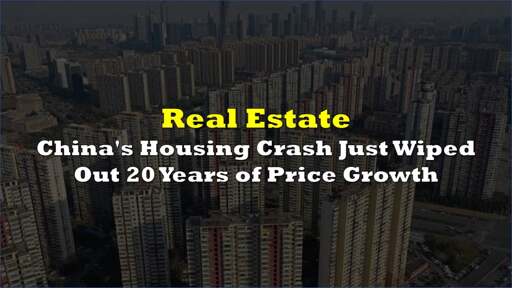
Inflation-adjusted home prices in China have fallen below where they started two decades ago, and the fiscal fallout is hitting local governments even harder than developers.
It peaked in 2021, so apparently prices have been declining for 5 years, and are still declining!!
The Chinese economy may be weird, but I don’t get how prices can fall below what they were 20 years ago, when China is much richer today than they were back then? We were told for a long time China was in a huge housing bubble, but this is crazy!
This will guaranteed ruin many peoples economy for decades even for the rest of their lives. And many will be tied to their house because it’s impossible to sell at a price that will clear the debt, so they can’t afford to move.
In a normal market it’s nice to own your own house, but a market like this, if you bought 5 years ago, it’s a nightmare.
China was building housing like crazy, and companies kept the prices artificially inflated, even though that created literal ghost towns and a number of buildings had to be demolished due to safety reasons…
Now with the bubble popped, prices are resetting to market value, and since this means a new swathe of newly affordable housing, that availability drives prices down even further.
Think of it like this: you’re sitting on 3 million tonnes of apples. You’re selling each apple for $50. Nobody but a few idiots are buying them. Then you suddenly need the cash, and start dropping the prices - you have to go below market rates to offload all those apples to raise capital. And the raw amount of supply means you’re going way under market prices, dragging other sellers with you.
Yes I know all that, bubbles result in stupid projects and poor quality, and banks stupidly believing growth will continue, so loaning to buy a house is easy. that’s the same here. I know how bubbles work.
But China has had an economic growth rate on an average of 10% many years of that period, it’s slowed down a bit in recent years but is still high.
But let’s say 15 years with 10% growth, that means the economy has grown 4 times in 15 years!!
So it’s crazy that prices fall back to less than when the economy was only 25% of what it is now.
Your description doesn’t explain that.
You’re also not truly buying the land, because private land ownership is illegal in China. Instead, you’re buying land usage rights for a long period (usually 70 years). Then it gets returned to the state (or the local farming collective, if you’re in a rural area that is managed locally) after your lease is up.
Basically, you can own your house, (the materials used to build it, the items inside of it, etc), but not the land it is built on. So after that 70 year lease is up, you (or more likely, your descendants) will need to either move off the land or sign a new land use contract with the applicable government (either local or state level).
And there’s always a chance that the government goes “actually we need to use that land for the public interest” and they can refuse to re-sign the lease. Maybe they want to turn it into a public park, or build a railway through the area, or use it for extra farmland. The same way the US government can seize an American’s land via eminent domain, the Chinese government can revoke a land use agreement.
But having an expected time the city can have the land back do helps with planning with development, or modernize run down buildings.
It being a lease means you also can very easily plan ahead your maintenance by funding it through the sale of the land upfront, not that much difference than collecting property tax except it is actually valued based on the land not the building on top of it.
It’s better if land is not owned by an estate forever.
Basically, you can own your house, (the materials used to build it, the items inside of it, etc), but not the land it is built on. So after that 70 year lease is up, you (or more likely, your descendants) will need to either move off the land or sign a new land use contract with the applicable government (either local or state level).
historically, europe had similar laws. the land and the farms on it were owned by two different people. the land was owned by the landlord but the farm was owned by the farmers.
many will be tied to their house because it’s impossible to sell at a price that will clear the debt, so they can’t afford to move
if housing prices fall, you get less money if you sell your old house but it also requires less money to buy your new house so it cancels out and you can move just as easily or difficultly as you could when prices were high.
No it does not cancel out, because when you lose money on your old house, you are left with that debt.
And having that debt makes it impossible to take a loan for a new house.
I’ve seen this work out in practice up to 10 years after the housing bubble burst in 2008. Where we visited many foreclosures people couldn’t afford to keep, and couldn’t afford to move away from. It’s a very bad debt trap that I think maybe USA has regulation to get out of, but IDK if other countries have that, we for sure don’t have it here.
Well no, not really. If they’ve turned their savings into a house, and they still have a house, and they could still move house if they wanted, they’ve lost nothing if the notional value of that house goes down.
(Just as most people don’t actually get any richer when the notional value of their house goes up - once you have a house you tend to always need a house; selling up to move into rented accomodation is something you do in distress, not a sign the housing market has played you a blinder. That means the only way anyone tends to realise that supposed value is - you guessed it - by getting into debt by borrowing against it.
Speculators and landlords of course - they benefit. But “won’t someone think of the parasites” is not a desperately compelling point of view.)
The value of housing is something to obsess over in countries where everybody is up to the eyeballs in debt secured on it. Where that is not the case, it’s far less important (and as it is essentially just the entry fee for independence, ideally it’s low, not high.) A fear of house prices ever actually going down, because of what that would mean to mortgage holders, is the reason the UK has a major housing crisis that it can’t do anything about (for example.)


It peaked in 2021, so apparently prices have been declining for 5 years, and are still declining!!
The Chinese economy may be weird, but I don’t get how prices can fall below what they were 20 years ago, when China is much richer today than they were back then? We were told for a long time China was in a huge housing bubble, but this is crazy!
This will guaranteed ruin many peoples economy for decades even for the rest of their lives. And many will be tied to their house because it’s impossible to sell at a price that will clear the debt, so they can’t afford to move.
In a normal market it’s nice to own your own house, but a market like this, if you bought 5 years ago, it’s a nightmare.
China was building housing like crazy, and companies kept the prices artificially inflated, even though that created literal ghost towns and a number of buildings had to be demolished due to safety reasons…
Now with the bubble popped, prices are resetting to market value, and since this means a new swathe of newly affordable housing, that availability drives prices down even further.
Think of it like this: you’re sitting on 3 million tonnes of apples. You’re selling each apple for $50. Nobody but a few idiots are buying them. Then you suddenly need the cash, and start dropping the prices - you have to go below market rates to offload all those apples to raise capital. And the raw amount of supply means you’re going way under market prices, dragging other sellers with you.
Yes I know all that, bubbles result in stupid projects and poor quality, and banks stupidly believing growth will continue, so loaning to buy a house is easy. that’s the same here. I know how bubbles work.
But China has had an economic growth rate on an average of 10% many years of that period, it’s slowed down a bit in recent years but is still high.
But let’s say 15 years with 10% growth, that means the economy has grown 4 times in 15 years!!
So it’s crazy that prices fall back to less than when the economy was only 25% of what it is now.
Your description doesn’t explain that.
Kinda like crypto, but with apples, you actually have apples.
The housing market is different in China. Most home are paid entirely at sale without a loan.
You’re also not truly buying the land, because private land ownership is illegal in China. Instead, you’re buying land usage rights for a long period (usually 70 years). Then it gets returned to the state (or the local farming collective, if you’re in a rural area that is managed locally) after your lease is up.
Basically, you can own your house, (the materials used to build it, the items inside of it, etc), but not the land it is built on. So after that 70 year lease is up, you (or more likely, your descendants) will need to either move off the land or sign a new land use contract with the applicable government (either local or state level).
And there’s always a chance that the government goes “actually we need to use that land for the public interest” and they can refuse to re-sign the lease. Maybe they want to turn it into a public park, or build a railway through the area, or use it for extra farmland. The same way the US government can seize an American’s land via eminent domain, the Chinese government can revoke a land use agreement.
But having an expected time the city can have the land back do helps with planning with development, or modernize run down buildings.
It being a lease means you also can very easily plan ahead your maintenance by funding it through the sale of the land upfront, not that much difference than collecting property tax except it is actually valued based on the land not the building on top of it.
It’s better if land is not owned by an estate forever.
historically, europe had similar laws. the land and the farms on it were owned by two different people. the land was owned by the landlord but the farm was owned by the farmers.
if housing prices fall, you get less money if you sell your old house but it also requires less money to buy your new house so it cancels out and you can move just as easily or difficultly as you could when prices were high.
No it does not cancel out, because when you lose money on your old house, you are left with that debt.
And having that debt makes it impossible to take a loan for a new house.
I’ve seen this work out in practice up to 10 years after the housing bubble burst in 2008. Where we visited many foreclosures people couldn’t afford to keep, and couldn’t afford to move away from. It’s a very bad debt trap that I think maybe USA has regulation to get out of, but IDK if other countries have that, we for sure don’t have it here.
Most people in China are buying with savings, not debt. Something like 80% of homes there are owned outright with no debt hanging over them.
The problem you are describing is a problem of consumer indebtedness, not house prices per se.
They still lose their savings, so not that much better.
Well no, not really. If they’ve turned their savings into a house, and they still have a house, and they could still move house if they wanted, they’ve lost nothing if the notional value of that house goes down.
(Just as most people don’t actually get any richer when the notional value of their house goes up - once you have a house you tend to always need a house; selling up to move into rented accomodation is something you do in distress, not a sign the housing market has played you a blinder. That means the only way anyone tends to realise that supposed value is - you guessed it - by getting into debt by borrowing against it.
Speculators and landlords of course - they benefit. But “won’t someone think of the parasites” is not a desperately compelling point of view.)
The value of housing is something to obsess over in countries where everybody is up to the eyeballs in debt secured on it. Where that is not the case, it’s far less important (and as it is essentially just the entry fee for independence, ideally it’s low, not high.) A fear of house prices ever actually going down, because of what that would mean to mortgage holders, is the reason the UK has a major housing crisis that it can’t do anything about (for example.)
OK good point.