
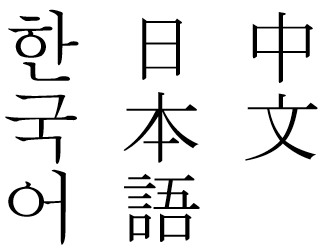
I mean, you can write in Chinese, Japanese or Korean vertically and the text remains legible they’re logographic (except Korean) so for both Chinese or Japanese: the nature of the writing system allows it for that level of flexibility when it comes to displaying text either vertically (R-L) or horizontally (L-R) while languages that use the Latin alphabet remain rigid on horizontal writing orientation only.
As in, you can display a Chinese or Japanese sentence top to bottom in vertical orientation but doing that with Latin-based languages (like English or French) makes it look crap. Today that form of writing still exists, Japanese has it in Manga where the text is formatted vertically and in Chinese it’s used for signage or pillars (Korean can be displayed in that format but it remains rare today).
With the Latin alphabet, fluent readers don’t recognize each letter individually—they recognize words and syllables based in part on the pattern of ascenders and descenders. Arranging the characters vertically disables that mode of pattern recognition.
With East Asian writing, each character represents a word or syllable, so those units don’t get disrupted by the vertical orientation.
So if you write a bunch of words with the Latin alphabet and stack them vertically as a sentence, is that a closer representation of East Asian writing?
I
guess
you
could
say
that.
deleted by creator
B
u
t
y
o
u
c
a
n
r
e
a
d
v
e
r
t
i
c
a
l
l
y
sorry lol
Sure, but you’re forced to fall back on parsing words letter-by-letter—you can’t read whole words at a glance like normal.