

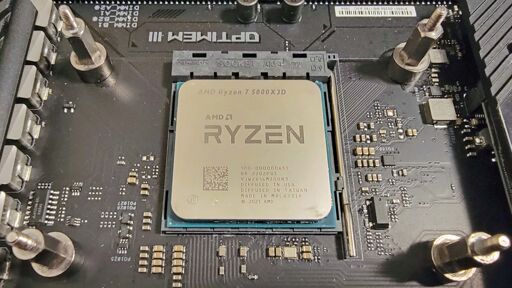
The average Ryzen 7 5800X3D is being sold for more money than a new Ryzen 7 9800X3D
Welp, time to make a straw doll of Sam Altman and start sticking it with pins. This bubble is taking way too long to burst.
Re: bubbles… People were calling BTC a bubble and it needing to burst in 2013. 13 years ago.
This is all propped up by growth though. The moment Microsoft mentions skipping a product cycle is when investors panic and rotate into staples or whatever, Nvidia cuts production targets, Micron suddenly has ICs for other things
Micron just taking the money that they can, it’s their progative. My point is that don’t necessarily wait around hoping for a burst, even if things look super frothy and bubbly. This is also propped up by speculation, which Bitcoin was too.
The valuation of these companies are based on absurd compounding growth but growth goes from darling to pariah the moment cash dries up, every time. Taper tantrums and Brexit era, it’s sometimes the knee-jerk reaction, even. 2021, people were trading based on yields and unemployment data and bad numbers were making tech stocks rise in hopes of rate cuts. Securities is an entirely different beast than bitcoin because stocks have intrinsic value (and if you have faith in the forward earnings of a company that’s intrinsic enough)
Specifically, it’s propped up by the growth of wealth inequality. Money is going less to poor people who need it for food and rent, and more to rich people who gamble on speculative bubbles. As long as they can afford to pump more money in, the bubble can continue.
While I get your sentiment, AI is different. They are making significant investments into hardware and real estate hoping to turn that into improvements of their models at significant cost. It is however only based on hopes and dreams that those will be realized. They are bleeding money for it and did not seem likely to reach break even ever.
I built my first PC a long time ago, with an AM4 board. I upgraded to 5800x3d a while back. Why do I feel like I’m going to keep using this same motherboard until I die?
Probably won’t be that long, but I would bet you’ll be using it until the 2030s.
AM4 has been a great platform. I’m now using a 5700x3d and it’s the 3rd cpu I’ve used with this system. That time I replaced the case as well, so it looks like a major upgrade at least.
I really wish they did another 5800X3D run (or even a 5800X3D XT). I missed the opportunity to buy it and the grey market prices are stupid.
I have a pretty solid AM4 rig; 3080 GPU (which is enough for my needs), x2 32 GB 16 CL 3600 memory. Tons of storage for HDD, PCIe 4 and PCIe 3 for different use cases, a solid cooling system.
I was planning to upgrade to AM5 next year, but I don’t think it’s happening. To be honest, the only way I am limited is the CPU.
I have a pretty similar setup but a Ryzen 9 5950X. The last thing I upgraded almost 2 years ago was the AIO and I never had any problems or limitations since then.
Luckily the times of massive jumps in graphics and stuff are over.
So glad I built my PC between the crypto craze and COVID. Feels like I won some sort of really fucked up gamble.
Thats misleading, yes prices CAN go that much but looking at what prices acturally are going for (sorting on ebay by recently sold) it seems the price is around $400-$600. These prices are not good by any means but keep in mind when it comes to AM4 CPUs you have less expensive options that are more than good enough, the 5900XT for example goes for half the price.
Yeah the 5900xt is what I’m looking at upgrading to. I didn’t realize it was actually a 16 core, the naming really threw me off.
My son, who has a 5800x3d, complained last week about skyrocketing ram prices, just when he wanted to buy some extra ram. I told him that’s mostly ddr5 ram and he needs ddr4 which is less affected. Apparently that’s not true anymore.
Edit: now he’s considering if he just wants to sell it and go without gaming for a while.
Turns out he only has the 5700x3d, although that’s still worth more than he paid for that plus his GPU.
Edit: now he’s considering if he just wants to sell it and go without gaming for a while.
IMO, not worth it unless the RAM is not in use.
What does ram use have to do with it? We’re talking about the CPU.
And as parent of a son in an exam year, I see a lot of value in him downgrading his PC.
I meant dealing with the hassle of downgrading and then upgrading the RAM. Might be easier to stick with what you have and not risk it with current shortages.
For sure, I am taking in a general manner.
You mean why everybody is suddenly flocking to DDR4 and AM4 CPUs? They might actually be new systems. If you need a new system, with the current prices you’re pretty much screwed. I don’t blame people for looking for creative solutions, but I’m really glad I buy my PCs a bit oversized so they will last me a long time. I can afford to ignore PC prices for a couple of years.
Yeah, I would just not risk doing a downgrade at this point. Where I live prices are elevated in general (import duties, less common and/or expensive SKUs tend to pieced even bigger) and things are only going to get worse.
With RAM specifically it can even be difficult to find certain high performance variants (this was back when DDR4 was being mass produced) at all.
I’m still running 5700g’s bought during the great GPU shortage. Now we’re dealing with the great RAM shortage and won’t be able to upgrade anytime soon. Life is pain lol.
Also have 5700G… still have a GTX card from Nvidia.
And here I am still with my hot old Piledriver…really missed the opportunity there
It’s insane how the prices on all of the X3D have held up compared to pretty much every other CPU line (irrespective of vendor).
It really helps that they’ve used the same socket for forever.
Wasn’t it because AMD replaced it with 5700X3D with a longer production run?
It was, I believe the 5700X3D is also not in production.
Upgrading from the 3700X to the 5700X3D was one of my best hardware choices.
I still have my 5600x going strong.
What are you gonna do with a 9800X3D without RAM? Upgrade the existing rig instead.
Got my 5800x3d in 22. Man I’m glad I built my system when I did. RIP PC gaming.
The games I’ve got aren’t going away. But new games should maybe stop aiming for the highest specs.
I bought the AMD R5 1600 (no X) in 2017 and overclocked it, ran on that until last year when I bought the Ryzen R7 5800X (no 3D).
This has been fine for me for gaming, I did spend a bit more on GPU, but still I’m doing fine on a modest budget for my PC IMO.
I did throw in a new motherboard for the 5800X, because the newer chipset is supposed to be better for the GPU/CPU communication.But a 7 year life on the old R5 1600 is insane, and then being able to upgrade to a new CPU on the same motherboard is crazy, although I upgraded the motherboard anyway.
From my perspective, a high end (at the time of purchase) desktop should still be usable in 10 years.
In 2023 I was working on an old laptop from 2014 with 760M and an i7-4702MQ, it was not the best (although I added an SSD and upgraded to 16GB RAM), but it did OK and could play older games just fine.
I aim for 10 years with a mid-life upgrade. I even do this with my laptops; my Inspiron got a new battery, a new CPU fan and an SSD for its 6th birthday. It’s 11 now.
My Ryzen 3600 rig is an HTPC now.
Well I think that’s stretching it, and my old R5 1600 did get a new GPU, but I also had a period where I had to use an older GPU because the original Radeon 5800 suddenly quit on me just before it reached 2 years. I got a full refund, because the GPU prices were insane at the time, and the Radeon 5800 cost more than twice what I gave originally even as a 2nd hand used card!
I simply refused paying that much, and played retro games on a Radeon RX 560 for almost a year, a card I had bought dirt cheap for about €100 for a media machine.
But a 7 year life on the old R5 1600 is insane
I think that it depends a lot on what one is doing.
So, a lot of games are bound on single-thread performance.
I have a Ryzen 9 7950X3D in my desktop. That’s the blingiest desktop AMD processor from 2023. That’s a six-year difference between release of those two processors and moving from a midrange to a top-end processor.
But despite all that.
https://www.cpubenchmark.net/compare/2984vs5234/AMD-Ryzen-5-1600-vs-AMD-Ryzen-9-7950X3D
It benches at less than twice the single-thread performance of the Ryzen 5 1600. It’s faster. But it’s not really transformatively faster. It used to be, in, say, up until the early 2000s, that you’d double serial computation performance every 18 months. A 6-year difference between processors, as between those two, used to mean that the newer one would run pretty much everything about sixteen times faster, even setting aside differences in the processor bin.
Parallel processing has improved at a better clip, either via adding more cores to CPUs or the massively-parallel computation on GPUs. So if software can really utilize parallel computation effectively, then one might get larger gains over that period. And for some software — and games are an area where some entrants can do that — they can take advantage. But for a lot of software, hardware just isn’t changing as quickly as it once did.
And for games, it’s very common that the way in which they can take advantage of more parallel compute is nice-to-have but not really essential ways, like bumping resolution up or adding some extra visual effects. It’s not “the game becomes unplayable because the game logic can’t keep up” or something like that, the way it typically would have been in the 1990s.
There are definitely things that one can do where parallel compute makes a larger difference. If you’re a computer programmer compiling software and your particular environment can do parallel builds, then you can often get a pretty linear performance increase in the number of cores. If you do 3D rendering or video rendering, you’re probably bounded by the CPU, and software is often written to take advantage of parallelism there. But the vast majority of software is mostly-limited by serial compute. And serial compute performance just hasn’t been increasing very quickly for quite some years.
And the GPU is generally more important than CPU for gaming.